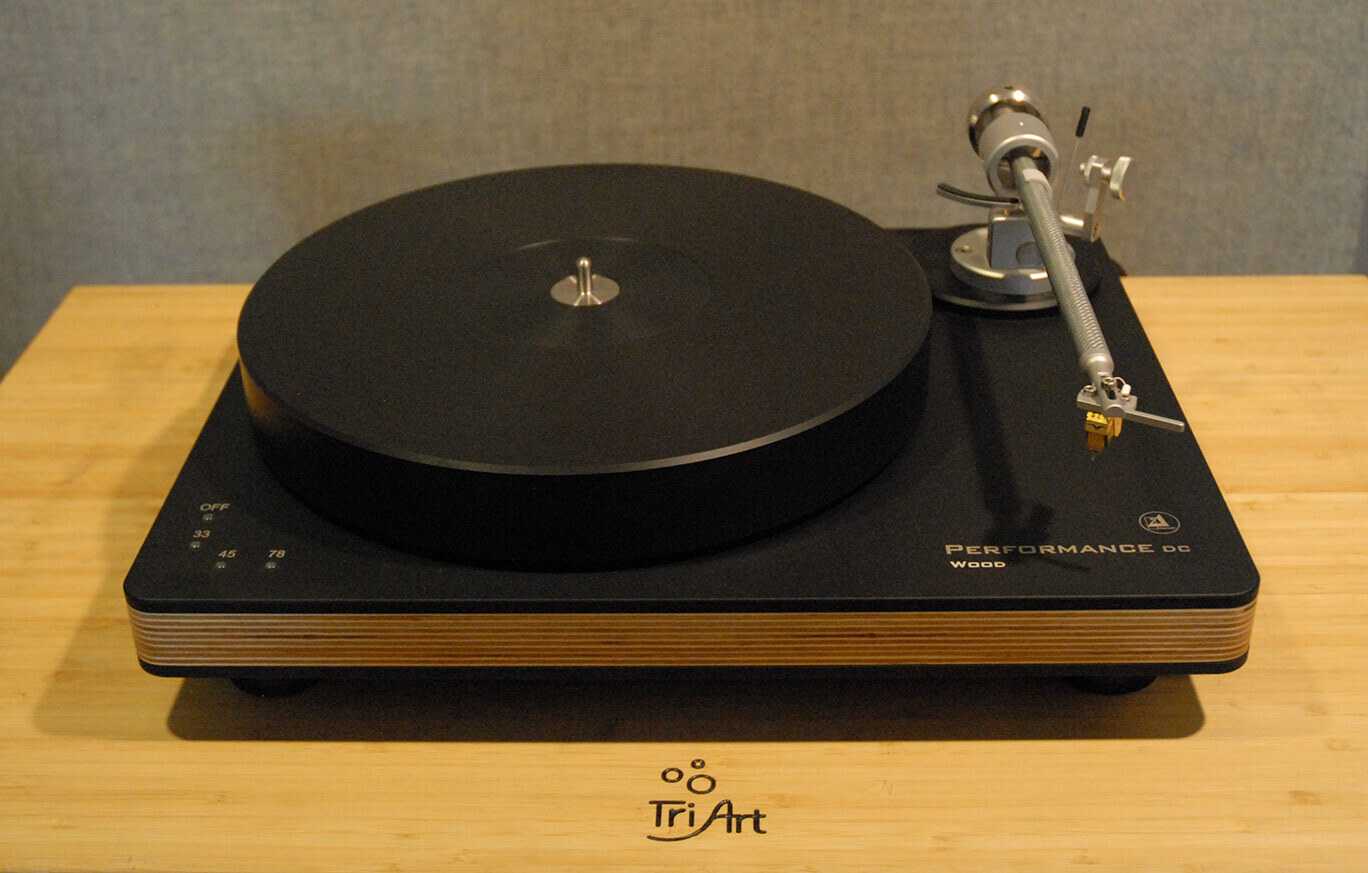
An analogue front end is the part of a hi-fi system that plays records: the turntable, the tonearm, the phono cartridge, and the phono stage that lifts a tiny electrical signal up to something your amplifier can work with. Every link in that chain shapes what you hear. Distinctive Audio has been setting up turntables for Ottawa listeners since 1986, and if four decades on Carling Avenue have taught us anything, it is that vinyl done properly is not nostalgia. It is one of the most satisfying ways to listen to music ever devised.
It is also the least forgiving. A digital source mostly works the moment you plug it in. A record player asks more of you — and of the person who sets it up. That is exactly why we think the analogue front end is worth buying from a shop with a setup bench, a protractor, and the patience to use both.
What Is an Analogue Front End?
A record groove is a physical map of a musical waveform, carved into vinyl. Playing it back is a mechanical act: a diamond stylus rides that groove, vibrating thousands of times per second, and those vibrations become a continuous electrical signal. Nothing is sampled. Nothing is reconstructed. The music stays a physical event from the groove wall to your loudspeakers, which is why every component in the path leaves its fingerprint on the sound.
Signal Path Basics
The chain runs stylus, cartridge, tonearm, phono stage, amplifier. The stylus traces the groove; the cartridge converts its motion into a voltage measured in thousandths of a volt — roughly 5 millivolts for a typical moving magnet design, a tenth of that for many moving coils. The tonearm's job is to hold the cartridge at precisely the right geometry while adding as little of its own behaviour as possible. The phono stage then applies RIAA equalization and enormous amplification to bring that whisper up to line level. A signal this small is fragile, so shortcuts anywhere in the chain are audible everywhere in the chain.
Core Components
The pieces that matter are the turntable itself (plinth, platter, bearing, and motor), the tonearm, the phono cartridge, the phono stage, and the record-care accessories that protect the investment — carbon fibre brushes, stylus cleaner, and inner sleeves. None of it is exotic, but all of it interacts, and a front end assembled as a matched system will outperform a pile of individually impressive parts.
Why Vinyl Still Matters
Records survived the format wars for real reasons. Many LPs receive a dedicated master with more breathing room than their loudness-maximized digital counterparts. A record collection is a physical library you own outright, playable on any turntable made in the last seventy years. And the ritual — sliding the record from its sleeve, lowering the arm, committing to a side — changes how you listen. You stop skipping and start hearing albums the way they were sequenced.
Ottawa's vinyl community reflects all of this. Between the record shows, the used bins, and the pressing renaissance of the last fifteen years, we meet first-time buyers and lifelong collectors every week — often at opposite ends of the same family. The gear below serves both.
Types of Analogue Gear Worth Buying
Turntables
The turntable's job is simple to state and hard to do: spin the record at exactly the right speed while isolating the stylus from every vibration that is not the groove. We carry lines chosen to cover that job at every level — Pro-Ject for honest, high-value decks from first table to serious reference, Rekkord for German-built automatics, Clearaudio for precision-machined German engineering, Gold Note for Italian design flair, and Oracle Audio, the Canadian marque whose suspended tables have been showpieces of the craft for decades. For listeners upgrading an existing deck, Graham and Reed tonearms are among the finest arms made. Our turntables page covers the current range in depth.
Phono Cartridges: Moving Magnet vs Moving Coil
The cartridge is where the physical world becomes an electrical signal, and it shapes the character of a system more than almost any other component at its price. Moving magnet (MM) designs output a healthy signal, work with nearly any phono input, and usually offer a user-replaceable stylus. Moving coil (MC) designs put the moving mass on the stylus end instead, trading output level for speed and resolving power; they ask more of the phono stage and reward it. Ortofon covers both camps superbly, and our MC shelf runs from Hana's remarkable-value designs through Dynavector, Benz Micro, and Charisma Audio. Our phono cartridges page goes deeper on the trade-offs.
Phono Stages
The phono stage is the most commonly underestimated component in vinyl playback. Amplifying a millivolt-level signal a thousandfold while applying accurate RIAA equalization is genuinely difficult, and the built-in phono inputs on many amplifiers treat it as an afterthought. A dedicated stage — such as Gold Note's PH-10, with adjustable gain and loading to suit almost any cartridge — is often the single most audible upgrade a vinyl listener can make. We also keep interesting stock on hand; a re-tubed Fosgate Signature valve phono stage is a recent example. See our phono preamplifiers page for what a good stage actually does.
Vinyl vs Digital: An Honest Comparison
We sell both, so we have no reason to spin this. On measured terms, digital wins: wider dynamic range, no surface noise, ruler-flat response. If the question is which medium is more accurate to the file on the server, digital is the answer.
But that is not the whole question. Many records are cut from masters with more dynamics left intact than their streaming equivalents, so the LP can genuinely be the better-sounding release of an album. A well-set-up analogue front end presents music with a body and continuousness that keeps people listening for hours. And the format asks for your attention in a way that streaming does not. The honest summary: digital measures better, vinyl frequently engages better, and a good system deserves both.
How to Choose Analogue Hi-Fi in Ottawa
Budget and Balance
Balance matters more than any single purchase. A sensible starting split puts roughly half the analogue budget into the turntable and arm, with the remainder shared between cartridge and phono stage — then adjust to taste as the system grows. A modest deck with a well-matched cartridge and a competent stage will embarrass an expensive table run through a neglected phono input. This is exactly the kind of arithmetic we work through with customers in the showroom, against the amplifier and speakers they actually own.
Room, Placement, and Isolation
Turntables live in the physical world. A springy wooden floor, a rack that resonates, or a shelf in the bass path of your speakers will put footfalls and feedback into the groove signal. Before spending on upgrades, make sure the table sits dead level on a stable, isolated surface away from the speakers' energy. Tell us about your room — century home with bouncy floors, condo slab, speakers close to the shelf — and we will match the table and isolation to the environment first, because the environment always gets a vote.
Musical Taste
What you play should steer what you buy. Large-scale orchestral works and dense rock recordings reward cartridges with composure and tracking security; small-group jazz and vocal records flatter designs with midrange richness; a crate-digger playing worn pressings has different priorities again. This is why we audition rather than recommend from a chart. Bring the records you know best to the showroom and let them decide.
A Practical Starter Chain
If we were building a first vinyl system from scratch, it would look like this: a Pro-Ject T1 fitted with an Ortofon OM 5E cartridge, into a phono stage — the amplifier's own input to begin, or a modest outboard stage when the upgrade itch arrives — into a good integrated amplifier and speakers. Add a carbon fibre record brush and LAST stylus cleaner from day one, because clean records and a clean stylus are the cheapest sound upgrade in all of audio.
The point of starting this way is the upgrade path. The same deck will happily accept a better stylus, then a better cartridge; the phono stage can grow into a Gold Note; and nothing you bought becomes obsolete. We also take trades, so the first table can help pay for the second. And for the mechanically curious, we even stock a build-it-yourself turntable kit from MITKIT — there is no better way to understand what a turntable actually does than to assemble one with your own hands.
Common Buyer Mistakes to Avoid
We have seen the same missteps for four decades. Skipping setup is the biggest: an unlevel table with wrong tracking force and rough alignment throws away most of what you paid for, and can wear records prematurely. Mismatching cartridge and tonearm compliance produces a wobbly, ill-tempered pairing no amount of money fixes. Running a serious cartridge into an afterthought phono input wastes the cartridge. Neglecting record and stylus care lets dust do permanent damage. And buying from a spec sheet instead of an audition leads to systems that impress on paper and fatigue in the living room.
Every one of these is avoidable, and most of them are why buying from a local shop still makes sense. Every turntable we sell leaves our bench properly set up — cartridge aligned with a protractor, tracking force and anti-skate dialled in, arm height checked — and we service what we sell for the long haul.
If vinyl is calling, start with your ears rather than a search results page. Bring two or three records you know intimately to our showroom at 903 Carling Avenue and hear what a properly set-up analogue front end does with them. Book a showroom demo and we will have a system warmed up when you arrive.