Walk into any serious listening room and the conversation almost always drifts toward the same question: what's feeding the speakers? Not the amp. Not the cables. The source.
The digital source has become the most argued-over, scrutinized, and frankly misunderstood component in a hi-fi chain. It's the part of the system that decides whether your music collection sounds like a recording or sounds like the actual event.
If you're shopping for a DAC in Ottawa, a music streamer, or a proper CD player, you're in a good spot. Distinctive Audio has been matching digital sources to real rooms and real music collections from our showroom at 903 Carling Avenue since 1986. So let's get into what actually matters, what we carry, and how to pick a source component that doesn't betray the rest of your system.
What Counts as a Hi-Fi Digital Source?
A hi-fi digital source is any component that reads digital audio data (whether from a streaming service, a local file server, or a disc) and prepares that signal for amplification. The category is broader than most people assume, and the boundaries get blurry fast.
Network Streamers
These pull music off the internet or your home NAS. Think Roon endpoints, Tidal Connect bridges, and dedicated transports that do nothing but shuttle bits cleanly to a DAC. The good ones obsess over timing, jitter, and electrical isolation. The great ones treat the network input like a contamination problem to be solved. Our music streamers page goes deeper on the current field.
Digital-to-Analogue Converters
The DAC is the translator. It takes the digital signal (PCM up to 24-bit/192 kHz and beyond, or DSD if you're into that) and turns it into the analogue waveform that your preamp can actually use. The conversion stage is where most of the sound quality battle is won or lost.
CD Players and Transports
CDs aren't dead. A surprising number of Ottawa audiophiles still spin discs, partly because the format remains an honest primary source for a lot of recordings that never made it to hi-res streaming. A dedicated transport feeding an external DAC is, oddly enough, having a quiet renaissance — and universal disc players extend the same idea to SACD and high-resolution disc formats.
Audition Your Next DAC or Music Streamer in Ottawa
Reading reviews is fine. Auditioning is better. At Distinctive Audio on Carling Avenue, digital sources aren't lined up on a shelf of blinking boxes — they're playing in a real two-channel system, through amplification and loudspeakers of the calibre you'd actually pair them with, in a room set up for listening rather than selling.
Bring your own music. That's not a courtesy, it's the whole point: you know how those recordings are supposed to sound, so you'll hear immediately what a better front end is doing. In a single sitting you can compare formats side by side — a hi-res stream of an album against the CD of the same album, a streamer's built-in DAC against a standalone converter — and hear where the differences are real and where they're marketing.
Demos are by appointment, which means the room is yours for as long as the comparison takes. And because we've been doing this since 1986, the first questions you'll get are about your room, your amplifier, and your music — the environment first, the box second.
Which Brands Define Audiophile-Grade Digital Playback?
The lines on our floor earned their place the only way that counts: by consistently delivering on their technical promises, at every price tier, year after year.
EverSolo
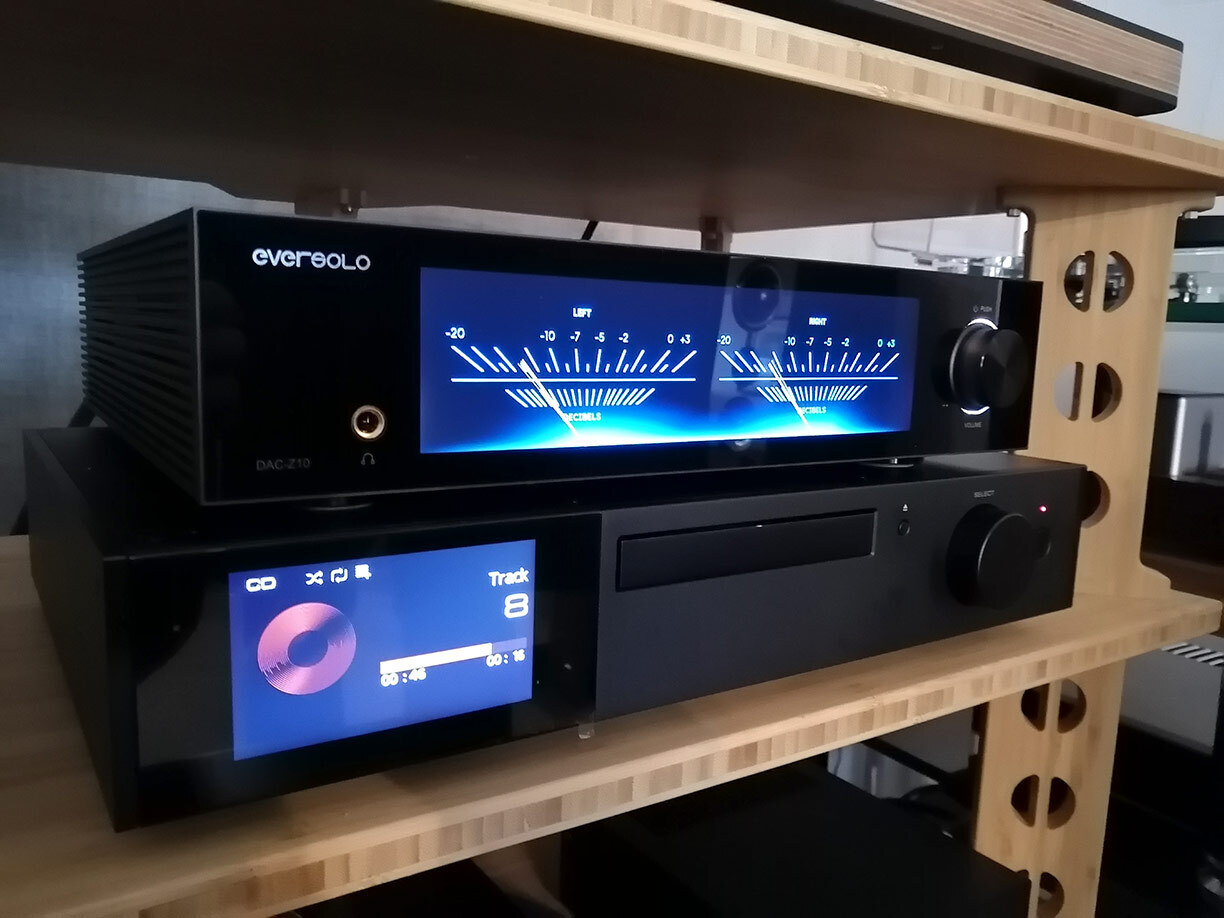
EverSolo came out of nowhere and now occupies a strange sweet spot: serious engineering at prices that don't induce nausea. Their streamers get praised for a low noise floor, linear power supplies, and a touchscreen interface that doesn't feel like an afterthought. We have EverSolo in the showroom right now, ready to audition.
Audiolab and Arcam
Audiolab is the sensible British answer to almost every digital question: the 7000N Play streamer for a clean network front end, the CD-T 7000 transport for disc duty, and the D7 DAC to tie it together. Arcam covers similar ground with the ST-25 and ST-75 streamers, both currently in stock — quietly competent boxes that measure well and never call attention to themselves.
Shanling and Magnetar
Shanling builds CD players the way they should still be built — the CD 2.1 pairs proper transport mechanics with a modern conversion stage. Magnetar is the name in universal disc players; the UDP-800 MKII handles CD, SACD, and high-resolution disc formats in one reference-grade chassis.
PS Audio and the Reference Tier
At the top of the range sits the PS Audio DirectStream DAC, an FPGA-based converter that has stayed relevant through years of firmware improvements rather than forced obsolescence. For listeners who want valves in the signal path, the Unison Research Unico Primo CD and the Audio Space T-88 tube CD player prove that disc playback and tube warmth aren't mutually exclusive — and both have passed through our floor.
How to Choose Between a DAC, Streamer, or All-in-One
This is where most buyers get stuck. The three paths each have a personality.
Standalone DAC Setups
Best if you already have a transport, a music server, or a computer you trust. You isolate the conversion stage and upgrade it independently when the next reference DAC comes along.
Dedicated Network Streamers
Pair with an existing DAC you love. The streamer handles network duties, file retrieval, and signal cleaning. You get flexibility and the ability to mix-and-match across decades of gear.
Integrated Streaming DACs
One box. Streamer, DAC, sometimes a preamp. Simpler. Less cable spaghetti. Slightly less ceiling for future upgrades. For most people building a second system or a tidy main rig, this is the rational choice.
Key Features to Compare Before Buying
Before you commit, run through this short checklist. Most disappointments come from skipping one of these.
- Resolution support up to at least 24-bit/192 kHz PCM, and native DSD if your library demands it
- Output options that match your amp (balanced XLR vs. single-ended RCA matters more than people admit)
- A linear or well-isolated power supply rather than a switching brick
- Galvanic isolation on USB and network inputs
- Roon Ready certification or gapless playback done properly, depending on how you listen
Supported Resolutions and Formats
If you're streaming Qobuz or Tidal, hi-res PCM handling is non-negotiable. DSD support is a bonus that some folks need and others never touch.
Output and Connection Options
XLR balanced outputs reject noise across long runs. Coaxial and AES/EBU digital outs let you split the streamer from the DAC. USB is fine but quality varies wildly between implementations.
Power Supply and Noise Floor
The power stage is the quiet hero. A clean linear supply does more for perceived detail than another DAC chip upgrade ever will.
Match the Source to Your Existing System
Here's the blunt part. A reference DAC into mid-tier speakers in an untreated room is a misallocation of money. The source should be roughly proportional to the resolving power of what comes after it. If your loudspeakers can't reveal the difference between an entry-level streamer and a PS Audio DirectStream, spend on the speakers and the room first. This is exactly the conversation we'd rather have before you buy than after — it's why the demo comes first.
Setup Tips for Ottawa Listeners
A few practical notes, learned over four decades of installations. Ottawa apartments and older homes both have quirky electrical situations, so a dedicated circuit — or clean power from something like a PS Audio Power Plant regenerator — pays dividends. Network-wise, hardwired Ethernet beats Wi-Fi every time for streaming stability. Digital interconnects matter more than the skeptics admit, which is one reason we still build custom cables by hand, terminated to the exact lengths your rack needs. And if your listening room has hardwood and tall ceilings (common in Glebe and Westboro homes), expect room treatment to matter as much as the source itself.
Follow-Up Questions Ottawa Buyers Often Ask
Most buyers circle back with the same handful of questions: Do I need a separate streamer if I already have a music server? Can I run a CD transport into a modern DAC? Should I trade in my old source when I upgrade? The short answers are: probably yes, absolutely yes, and bring it in — our trade-in program exists precisely for this moment in a system's life.
Building a great digital front end has never been easier, and the technology has matured to the point where bit-perfect playback is the floor, not the ceiling. What separates a good system from a great one now is matching — the source to the amplifier, the amplifier to the speakers, the speakers to the room. That's the part a spec sheet can't do for you.
Take your time. Audition more than you think you need to. And when you're ready to hear what your music actually sounds like through a properly sorted digital front end, book a showroom demo at 903 Carling Avenue — bring the records you know best, and we'll take it from there.