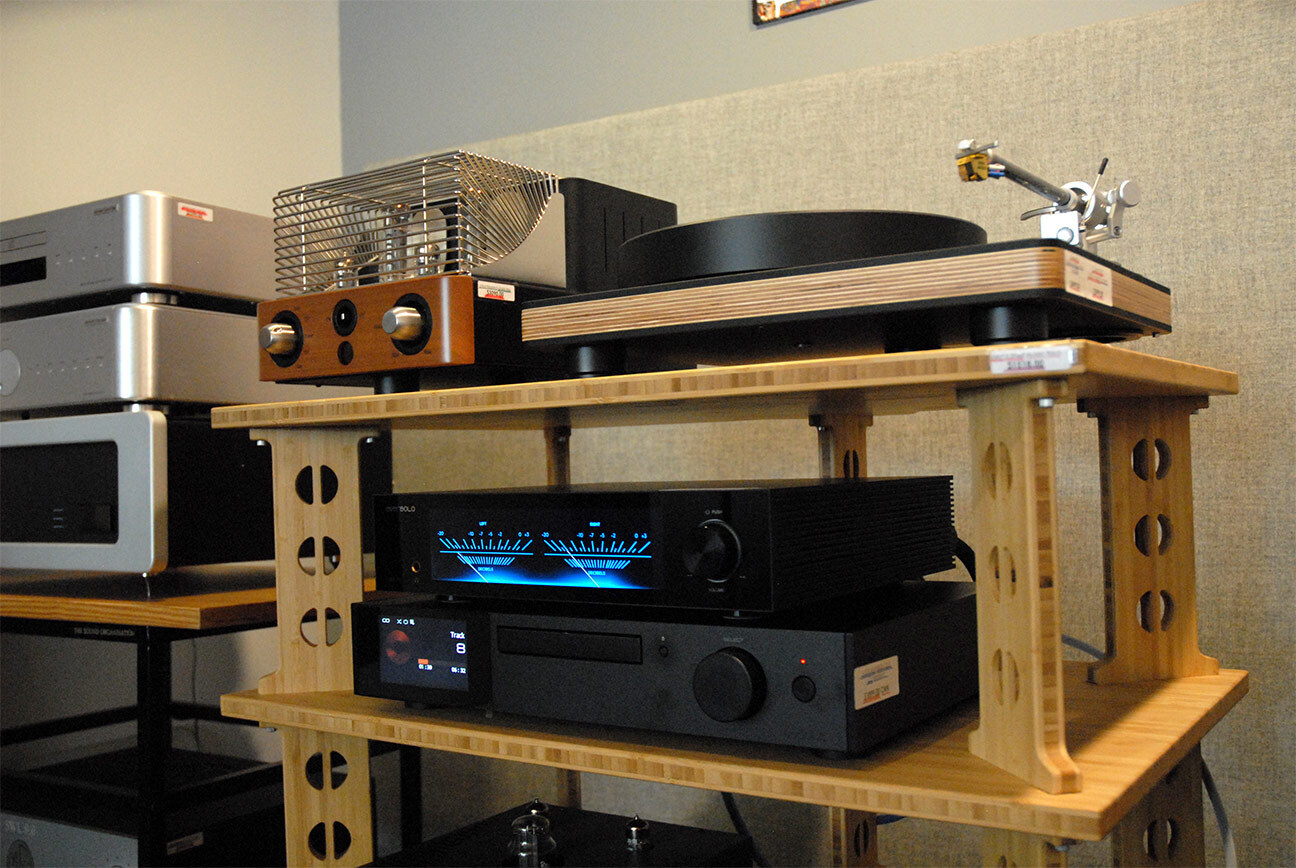
Walk into any serious listening room in Ottawa, from a Glebe condo to a Kanata basement build-out, and one piece of gear quietly does more than people give it credit for: the rack. The thing your amp sits on. We obsess over speakers, DACs, cartridges, the latest tube rectifier, and then we plunk the whole signal chain onto a wobbly sideboard and call it a day. That's the part worth rethinking.
A proper hi-fi rack is a vibration-control device first and a piece of furniture second. Everything from soundstage depth to bass articulation can shift, sometimes subtly and sometimes dramatically, depending on what's holding your gear. The accessories that go along with it (isolation platforms, footers, cable dressing) do the cleanup work the rack alone can't.
Distinctive Audio has been matching audio racks to Ottawa listening rooms since 1986, and every line we stock — Norstone, Tri-Art, IsoAcoustics, Black Diamond Racing — is on our floor at 903 Carling Avenue, supporting real systems you can listen to. Here's where the money actually pays off.
Why a Dedicated Hi-Fi Rack Matters for Sound Quality
Plenty of folks dismiss racks as pure aesthetics. Careful listening suggests otherwise: move a turntable from a wobbly sideboard to a rigid, level rack and the difference is easy to hear. How much difference depends on your system's resolving power and on how vibration-sensitive the component is — which is exactly why vibration control pays off most under turntables and tube gear.
Resonance and Vibration Control
Every transformer hums. Every speaker pressurizes the room. That mechanical energy travels through the floor (especially the hardwood floors so common in older Ottawa homes) and back up into your gear. A dedicated rack with damped feet and decoupled shelves interrupts that loop. Turntables benefit the most. Tube amps a close second.
Heat Dissipation and Component Safety
Stacking a Class A amp on top of a preamp is asking for trouble. Open-frame designs with generous shelf spacing let warm air escape, which extends tube life and keeps capacitors from cooking themselves over a long winter of indoor listening.
Signal Integrity and Noise Floor
Tidy routing matters. When power cords and signal interconnects are crossed or coiled together inside a flimsy cabinet, induced noise creeps in. A purpose-built rack gives you separation between high-current and low-level lines, which lowers the noise floor in ways you'll notice on quiet passages.
How Rack Materials Affect Performance
Material choice isn't dogma, it's a trade-off between stiffness, mass, and damping behaviour. It's also the part of this category that rewards a little chemistry: every material stores and releases vibrational energy differently, and the lines we carry cover the approaches that genuinely work.
Bamboo Shelving: Tri-Art and Norstone
Bamboo's dense, interlocked fibre structure gives it a natural self-damping character that softens high-frequency resonance without deadening the sound. Tri-Art, a Canadian builder, takes the material further than anyone: thick strand-woven bamboo racks, amp stands, and platforms, all of it warm-looking enough to sit happily in a mid-century living room. Norstone offers bamboo shelving in its range as well.
Tempered Glass and Steel: Norstone
Steel adds mass and stiffness; tempered glass adds a rigid, dead-flat, easy-to-level surface. Norstone's racks — the Esse, Loft, and Staabl among them — combine steel framing with tempered glass, steel, or bamboo shelving, which is how they hold serious weight without flex while still looking like furniture rather than scaffolding.
Carbon Fibre: Black Diamond Racing
Carbon fibre is extraordinarily stiff for its weight, and its layered construction dissipates vibrational energy rather than storing it and ringing it back. Black Diamond Racing's carbon-fibre cones bring that behaviour to the space between a component and its shelf — a small, dense intervention that does outsized work under amplifiers and sources alike.
Rack Configurations for Ottawa Listening Rooms
Room shape dictates rack shape, and Ottawa homes are all over the map: narrow Centretown row houses, sprawling Orleans rec rooms, lofted Hintonburg conversions.
Modular Stackable Racks
These are the workhorses. Start with three shelves, add more when the collection grows. The Norstone Loft is built exactly this way, and Tri-Art's open-frame bamboo racks extend the same idea — begin with what you need and grow without replacing what you own.
Wall-Mounted Supports
Underrated for turntables. A wall shelf decouples the deck from the floor entirely, which is a godsend if you live above a busy street or share walls with neighbours who close doors with conviction.
Fixed-Shelf Audiophile Towers
Built-to-spec, often with fixed shelf spacing tuned to common chassis heights. Less flexible, but mechanically very stable, a strong choice for a reference system.
Essential Audio Accessories Worth the Investment
Not every accessory earns its place. Some genuinely change the sound. Others change your wallet. The categories that consistently deliver:
- Isolation under sources: An IsoAcoustics Zazen platform or Black Diamond Racing cones beneath a turntable or DAC tighten bass and reveal low-level detail. The effect is most obvious with vinyl playback.
- Anti-vibration platforms: A Tri-Art RPRA platform between the shelf and a heavy component can clean up midrange congestion in busy passages.
- Cable management sleeves and separators: Keeping power away from signal isn't an upgrade, it's hygiene.
- Anti-static record brushes and stylus tools kept in the rack zone: Boring, but they protect a $1,500 cartridge from a $5 piece of dust.
Isolation Footers and Platforms
The decoupling-versus-coupling debate will outlive us all. Both schools work; what matters is matching the device to the component. Heavy amps generally prefer coupling — rigid points like Black Diamond Racing's carbon-fibre cones. Lighter, sensitive sources (turntables, tube preamps) prefer decoupling — the IsoAcoustics Zazen platform or a Tri-Art RPRA device. In our experience demonstrating isolation under a turntable in the showroom, the before-and-after takes about a minute to hear and considerably longer to un-hear. There's a deeper dive on our cones and isolation page.
Cable Management and Routing Tools
Velcro ties, woven sleeves, and proper strain reliefs. The least glamorous upgrade in audio, and one of the most consequential for long-term reliability. It's also half the reason we hand-build custom cables to length — tidy routing is much easier when there isn't two metres of excess to hide.
How to Match a Rack to Your Components and Budget
A rack rated for 50 pounds per shelf is not the rack for your 90-pound monoblocks. Sounds obvious. People still get it wrong.
Weight Capacity and Shelf Spacing
Measure your tallest chassis, add four inches of breathing room, and double-check the spec sheet. Tube amps need more vertical clearance than the manufacturer's photo suggests.
Turntable, Tube Amp, and Reel-to-Reel Needs
Turntables want isolation and a dead-level surface. Tube amps want ventilation and mass. Reel-to-reel decks (which are quietly making a comeback among Ottawa collectors) need depth, real depth, the kind most consumer furniture doesn't offer.
Entry, Mid, and Reference Picks From Our Range
For a first dedicated rack, the Norstone Loft is the natural starting point: modular, expandable, and a genuine step up from furniture. Moving up, the Norstone Esse and Staabl and Tri-Art's bamboo racks and amp stands add mass, stiffness, and better damping for turntable-based and tube systems. And at any tier, isolation is where a reference-level improvement hides: an IsoAcoustics Zazen platform, Black Diamond Racing cones, or a Tri-Art RPRA platform under the right component will often outperform a costlier rack swap. You'll find current stock on our racks page, and all of it set up on the showroom floor.
What to Check Before Buying Audio Racks in Ottawa
Room Humidity and Hardwood Floors
Ottawa winters are brutally dry, summers humid. Solid wood expands and contracts with the swing; engineered strand bamboo and tempered glass handle it far better, which is part of why our rack lines lean on those materials.
Audition Before You Commit
A 200-pound rack is not something you want to return-ship. We've been setting up racks and isolation in customers' rooms across the region since 1986, and the honest answer is that the right choice depends on your floor, your components, and your ears. Come listen first.
Compatibility With Existing Furniture
Match wood tones, sightlines, and column geometry. A reference rack that looks like a science experiment in a heritage Sandy Hill living room defeats half the point of owning beautiful gear.
Common Mistakes Audiophiles Make With Racks and Accessories
Three patterns we see again and again:
- Spending on premium racks before fixing room acoustics. Bass traps and first-reflection panels come first. Always.
- Stacking components directly on top of warm amplifiers. Heat kills electrolytics, full stop.
- Buying isolation footers without knowing what they're isolating from. Coupling and decoupling solve different problems.
A good rack is invisible work. It doesn't dazzle anyone at a listening session, and nobody walks in praising your shelf material. What it does is let everything else you've spent money on actually perform. For Ottawa listeners juggling humidity swings, hardwood floors, and rooms that weren't designed for high-end audio, the right support system is one of the highest-leverage investments in the chain.
The easiest way to hear it is in person. Book a showroom demo at 903 Carling Avenue and we'll show you what a rigid rack and a well-placed isolation platform do under a turntable — with your kind of music, at your pace. We've been doing exactly that since 1986.