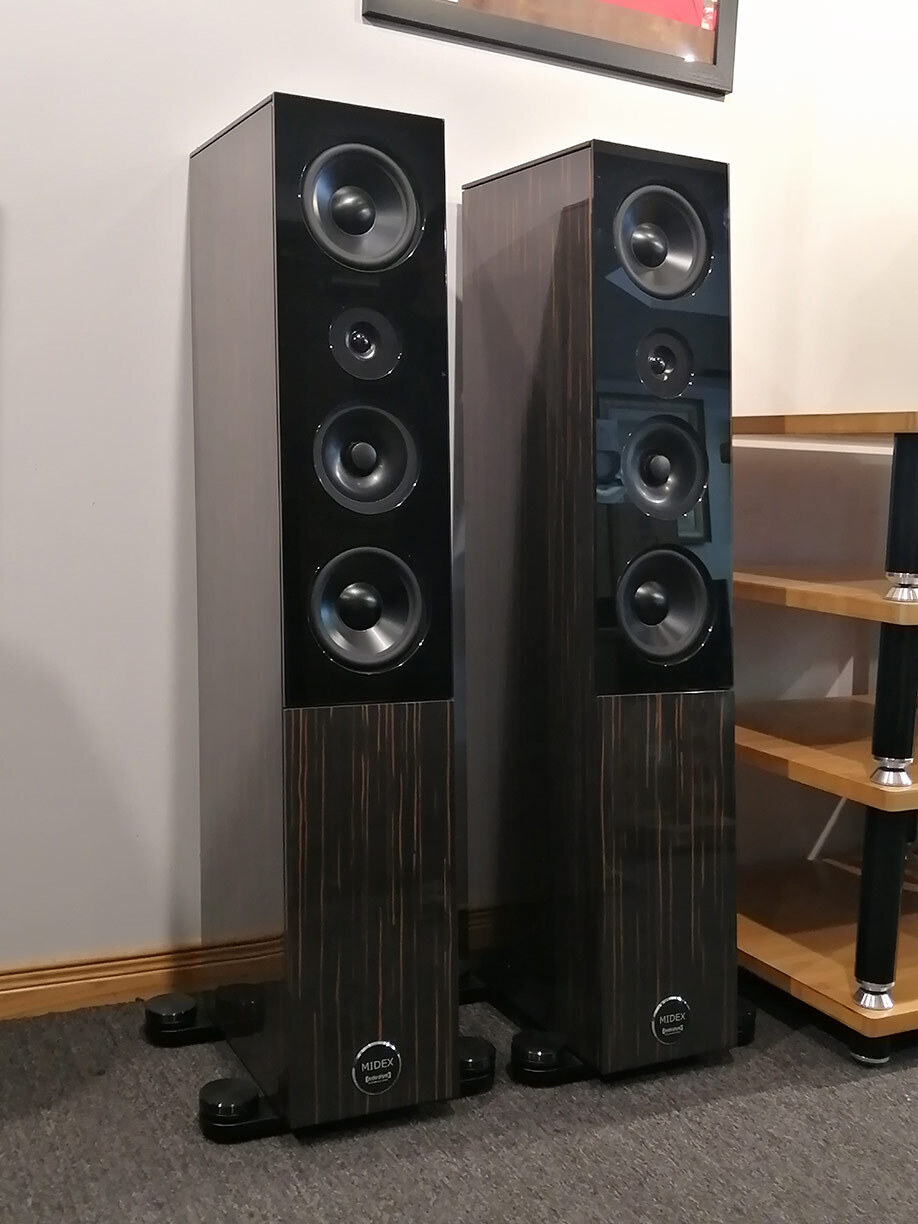
Loudspeakers are the most personal decision in a two-channel system. Amplifiers and sources matter, but the speakers are what actually move the air in your room, and the right pair depends as much on that room — and on the music you love — as on anything printed on a spec sheet. No two rooms sound alike, and no two listeners want quite the same thing from them.
If you are shopping for loudspeakers in Ottawa, we would make the case for doing it the old-fashioned way: sitting down in a proper listening room and hearing them with your own music. Distinctive Audio has been matching speakers to listeners from our showroom at 903 Carling Avenue since 1986, and four decades have taught us one durable lesson — the speaker that wins on paper is not always the one that disappears in your living room.
Loudspeakers in Ottawa: What We Carry and Why
We keep our loudspeaker roster deliberately short. Rather than stocking a wall of brands, we carry a handful of lines we know intimately — well enough to voice a complete system around them, demonstrate them properly, and stand behind them years after the sale.
MartinLogan: Our Electrostatic Specialty
MartinLogan is the line we are best known for. Their electrostatic hybrids, such as the ESL 9, pair a near-massless electrostatic panel with a conventional powered woofer, so you get the transparency of a panel with a real bass foundation underneath it. Their Motion series brings a related philosophy — a fast, precise folded-motion tweeter — to conventional cabinets at friendlier prices, from stand-mount monitors to full towers.
Unity Audio: Sealed-Box Honesty
Unity Audio takes the opposite approach: sealed cabinets voiced for accuracy first. The Warrior V2 and Whitewater V2 deliver tight, articulate bass and a midrange that tells you exactly what is on the recording. If your listening leans toward voices, acoustic music, and small ensembles, they are worth a long audition.
Audio Physic: In Stock and Ready to Hear
We currently have Audio Physic Classic 15 floorstanders on the showroom floor. These German towers are compact enough for a real-world living room yet throw the wide, stable soundstage the brand is known for — a good example of how a slim speaker, properly placed, can sound much bigger than it looks.
Bookshelf, Floorstanding, or Electrostatic?
Before comparing brands, decide which type of speaker your room and your listening habits actually call for. Each format has a distinct set of strengths, and the room usually casts the deciding vote.
Bookshelf Speakers
Bookshelf speakers are the right answer more often than their size suggests. In a small or medium room, a good stand-mounted pair images beautifully, pressurizes the space without overloading it, and leaves you room to add a subwoofer later if you want the bottom octave. They do their best work on proper speaker stands rather than on furniture — height and isolation matter more than most buyers expect.
Floorstanding Speakers
Floorstanding speakers move more air, so they reach deeper and play louder without strain. In a larger room they deliver the scale and weight that a compact monitor simply cannot, and they do it without a separate subwoofer to place and blend. The trade-off is that they interact more strongly with the room, which makes placement — and an honest audition — all the more important.
Electrostatic Panels
Electrostatic panel speakers are the specialty of the house. A panel radiates sound from a large, nearly weightless diaphragm rather than a heavy cone, and the result is a level of transparency and low-level detail that keeps listeners in the chair long after the demo was supposed to end. They ask a little more of the room and the amplifier, which is exactly why we keep them set up and playing rather than sitting in boxes.
Electrostatic vs Dynamic Drivers: What You Actually Hear
Most speakers use dynamic drivers — cones and domes driven by a voice coil. An electrostatic replaces that with a thin film suspended between two charged panels, driven evenly across its whole surface.
How an Electrostatic Panel Works
Because the diaphragm weighs almost nothing, it starts and stops almost instantly. In listening terms that means texture: the breath before a vocal phrase, the decay of a piano note, the sense that instruments occupy real positions in space. MartinLogan's curved panels also widen the listening window, so the effect is not confined to a single seat the way older flat panels were.
Where Dynamic Drivers Hold the Advantage
Dynamic speakers move more air per square inch, so they generally deliver more bass weight and higher output from a smaller footprint, and they are less particular about placement. This is why MartinLogan's hybrids pair a panel with a dynamic woofer — and why, for many rooms, a well-executed dynamic speaker like the Unity Audio monitors or the Audio Physic towers is the better match. Neither technology wins in the abstract; your room and your music decide.
Matching Speakers to Ottawa Homes
We have set up systems across the Ottawa–Gatineau region for a long time, and the housing stock here spans everything from downtown condo towers to century-old brick homes in the Glebe to open-plan builds in the suburbs. Each presents a different acoustic problem.
Condos and Apartments
Shared walls and concrete floors reward speakers with controlled, articulate bass over sheer output. A sealed monitor or a modest floorstander, positioned well, gives you satisfying listening at reasonable levels — and keeps the relationship with your neighbours intact. Isolation under the speakers or stands helps here too, keeping bass energy out of the building's structure.
Brick, Plaster, and Drywall
Older Ottawa homes with brick and plaster walls are acoustically stiff: bass stays in the room, and boundary reinforcement is strong, so speakers often want to sit farther from the walls. Newer drywall construction absorbs and leaks more low-frequency energy, which can leave the same speaker sounding leaner. This is one reason we ask about your room before we recommend anything — the building itself is part of the system.
Placement and Room Acoustics
Placement is free performance. Distance from the front wall sets the bass balance, distance between the speakers and toe-in set the soundstage, and the first reflection points at the side walls decide how clean the midrange stays. Panels need breathing room behind them because they radiate rearward as well. When you buy from us, this is not left as an exercise for the reader: we talk through your room, your furniture, and your seating before the speakers ever go home.
How to Audition Speakers Properly
An audition is not a formality — it is the whole point. Here is how to get real information out of one.
What to Bring
Bring your own music, not audiophile test tracks. Choose four or five recordings you know so well you could hum the room tone: one with a voice you love, one with real bass, one that is densely mixed, one that is quiet and spare. Rough dimensions of your room — even a phone photo — help us set up something representative.
How Long to Listen
Longer than feels polite. First impressions favour speakers that are bright and forward; the pair you can live with for a decade reveals itself over a full unhurried session, and sometimes a second visit. We book demos so that nobody is standing over you waiting for a decision — that is what an appointment at our Carling Avenue showroom is for.
Listen Past the First Impression
Switch back and forth between candidates at matched volume, listen from off-axis seats as well as the sweet spot, and pay attention to whether you are following the music or analyzing the sound. The right speaker makes you reach for the next album. If a pair impresses you for ten minutes and tires you in forty, that is your answer.
The Case for Two Channels Done Right
We are a two-channel shop by conviction. A carefully chosen stereo pair, matched to the room and fed by good amplification, produces a deeper illusion of real music than a larger number of lesser channels ever will. Speakers and amplifiers succeed as a pair: an electrostatic panel wants an amplifier that is comfortable with its load, and a sealed monitor comes alive with clean, unforced power. Whether that means a tube integrated from Unison Research or PrimaLuna or a solid-state design from Audiolab, we voice the match in the showroom rather than guessing from spec sheets.
Trade In and Move Up
Loudspeakers are rarely a final purchase — tastes deepen, rooms change, and the itch to upgrade is part of the hobby. Our trade-in program gives your current speakers a fair value against the next pair, and our used and consignment stock means the pair you traded finds its way to a listener who will appreciate it. It is one more reason a relationship with a local shop beats a courier box: the people who sold you the first pair are still here for the third.
The best way to choose loudspeakers is still to hear them. Book a showroom demo at 903 Carling Avenue, bring the music that matters to you, and take the time to listen — we have been doing it this way in Ottawa since 1986.